

Welcome to another edition Doomscrolling With - a new series in which I corner smart people in the GOP campaign ecosystem and force them to answer my questions about data, digital, fundraising, advertising, and whatever else I happen to be hyper-fixated on at the moment!
This week we’re talking to the one and only John freaking Hall about how to build a brand, grow an effective fundraising program, and the single biggest lie told to Republican campaigns.
Now let’s get to some scrolling!
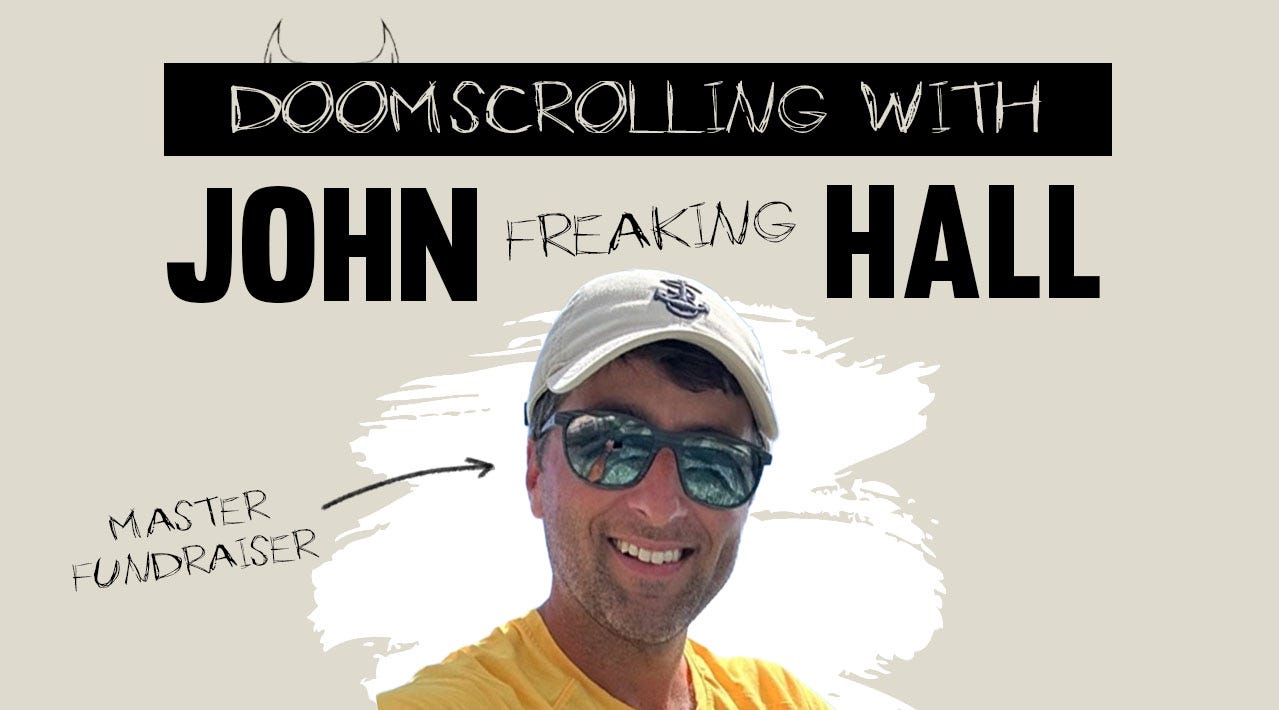
First of all, who are you and what do you do?
I’m John Hall. I’ve been doing digital fundraising and political marketing full-time for 15 years and was a grassroots organizer and statewide campaign manager before that. I spent the largest part of my career at Targeted Victory, and today I run John Hall Strategies, a small digital marketing agency.
Over my career, I’ve helped raise more than $1.6 billion online. I’ve seen this industry from a lot of different angles and watched it change dramatically.
The thing I probably spend the most time thinking about now is where digital goes next. I think the model that worked incredibly well for us for a long time is showing serious flaws.
Alright, John Hall. You’ve been pretty outspoken in recent years about what’s wrong with the online fundraising industry. So let’s start on a positive note: What are we getting RIGHT in 2026?
I am sure this will surprise you, but we get a lot right.
The technology, the data, the ability to process contributions, deploy emails and texts, and analyze behavior are light years ahead of where they were when I started.
The fact that every campaign and organization thinks about online fundraising today is a win and far different from a decade ago.
There are a lot of smart people in our industry. My criticism sometimes gets interpreted as me saying everyone is bad at their jobs and everything is terrible. I don’t believe that at all.
What I think we’ve proven is that Republicans can quickly build operations for monetizing political attention. When big moments happen, we can quickly flood the zone and drive a ton of donations.
Talk about how the GOP online fundraising ecosystem has changed since your days at Targeted Victory. Today we have access to better tools, better data, and an entire cottage industry built around raising money online. But are we actually better fundraisers than we were a decade ago?
We’re more educated fundraisers, and there are a lot more of us, but I’m not sure we’re better fundraisers.
When I first worked in digital, sending emails for a state party in 2007, we had far fewer tools and almost no data. If a candidate or organization wanted to raise money, they had to build a list, create a marketing plan, and hope the lead generation was done properly. Email rentals and rev shares existed, but they were more of a supplement than a dominant channel for fundraising.
Today, a client has access to the entire Republican online donor file on the first day they start their program through rev shares. This creates opportunity, but it also creates enormous competition among everyone in the ecosystem. This also encourages everyone to create content that is as shocking to the recipient as possible to capture attention.
We can also optimize almost everything very easily. We know which topics generate the most revenue, which rev-share vendors perform best with specific hooks, and which psychological appeals are working best at any given moment. The challenge with this high level of optimization is that sometimes it can make you incredibly good at maximizing the wrong thing.
If everyone is measuring success based on how much money they can extract from the same donor pool today, you end up with hundreds of individually rational decisions that collectively destroy the entire market.
That’s basically what I think has happened.
We’ve gotten extraordinarily good at monetizing existing Republican donors. We haven’t gotten nearly as good at creating new ones.
You can see that in the numbers. Democrats have built a much larger grassroots fundraising base. Republicans have built an entire industry around repeatedly monetizing a comparatively smaller one.
We’ve gotten extraordinarily good at monetizing existing Republican donors. We haven’t gotten nearly as good at creating new ones.
I really want to press you on what it takes to build a successful fundraising program right now. There was probably a time when being a Republican senator, having a leadership role and doing regular hits on Fox was enough to make you a national fundraising machine. I’m not sure that’s true anymore. Tell me why I’m wrong. Or do you agree?
Those factors don’t automatically make a program successful.
I think there was a period when the formula was simpler. If you had national television exposure, rented some good lists, and had competent copywriters with a somewhat unique message, you could build a national fundraising program.
That’s much harder today for a lot of reasons, one of which is that attention is much more fragmented.
Being important and getting on news shows isn’t necessarily the same thing as being interesting.
The people who become great online fundraisers generally have something else going on. There’s a reason people care about them beyond the fact that they’re a senator or a candidate for governor. There is a uniqueness that makes them stand out. I think donors generally want to give to something they believe in or a shared vision they want to be part of. The campaign is really the vehicle for that belief.
We have talked about using social media more effectively to build a brand that then translates into better online fundraising. I think social media is an important tool, but it all goes back to having something interesting and captivating to share in the first place.
A great fundraising team can amplify something that’s there. It’s much harder for them to manufacture it from nothing.
Ok so here’s my follow-up to that. Does fundraising have to start much further upstream now? Before we talk about the lists or the copy, do we have to give people a reason to actually care about the candidate? If not, tell me how a fundraising team can overcome a candidate who hasn’t built a real brand or audience of their own.
Yes, and this may be the biggest change in how I think about fundraising.
We used to think about the funnel too narrowly. We talked about online fundraising as more of a math problem and less as an audience and content puzzle to solve. You acquire an email address or phone number, send that person fundraising messages, and try to convert them. It was almost a hammer-to-nail exercise.
The real funnel starts much earlier. Why does someone know who you are in the first place? Why do they care what you have to say? What makes them decide to follow you or give you their email address? And then, once you have it, why would they keep opening your emails? You have to build some kind of relationship before you can expect the fundraising ask to work.
We’ve gotten into the habit of trying to skip all those steps and go directly to the $25 fundraising ask.
I’ve changed my own thinking on lead generation. A few years ago, I argued that donors give you money and leads cost you money. I now think that was too simplistic. A high-quality audience that you’ve built a relationship with can ultimately be much more valuable than people who donated in response to a generic or even misleading fundraising hook.
All the folks raising money by offering rebate checks or requiring a donation to complete a voter verification survey will find this out over time. I believe this is a large reason why the cost of fundraising for Republican organizations keeps going up even as we become more efficient than we have ever been.
If the candidate or organization hasn’t built a brand to anchor to, the fundraising team can help, but there are limits. You can’t email and text your way out of nobody caring.
Take off your fundraiser hat for a second. If you were a general consultant working on a high-profile Senate race, what would you tell the candidate is a more valuable asset: a list with 500,000 emails or an audience of 100,000 engaged voters? How should a campaign think about those things differently?
Reading some into what you are getting at with this question, I’d take the 100,000 engaged voters.
If 100,000 people want to hear what this candidate has to say, that’s an asset in itself. A relationship with a voter is a connection that extends beyond just a marketing channel.
And that’s also why I think campaigns need to stop thinking about their email list, donor file, volunteer list, event attendees, and voter contacts as completely separate assets. Those are all different pieces of the campaign’s relationship with people. Ideally, they should all feed into one place so the campaign can understand the whole relationship rather than just what someone did in a single channel. The asset isn’t the email address or the donor record. The asset is the person and the relationship you have built with them.
You can eventually ask these folks to donate, volunteer, attend an event, share something, vote, or bring other people into the movement. That gives the campaign a lot more optionality than a list of 500,000 email addresses that may or may not even be local.
This gets back to something I’ve argued about local fundraising. Not everyone needs to become a national celebrity. A senator with 100,000 genuinely engaged people in his or her own state may have built something much more durable and valuable than a giant national list assembled through rev shares.
You can’t email and text your way out of nobody caring.
So whose job is it to make a candidate a better fundraiser with a bigger brand? Like, do YOU want to be the person in the room who has to tell a candidate he needs to post more compelling content on Instagram?
That falls on everyone involved.
That’s probably an uncomfortable answer because campaigns are still organized into silos. For many organizations, you have the general consultant and a campaign manager and then communications, digital, finance, political, paid media, polling, and social teams.
The voter doesn’t know any of those silos exist or where what they are seeing, or not seeing, is coming from. They just experience the candidate through the things they see.
The digital fundraiser may need to say, “The problem isn’t the copy. The problem is that we don’t have anything interesting to say,” or, “We need the candidate making more content,” or, “We need to spend money building an audience even though it won’t show a positive fundraising ROI this week.”
That doesn’t mean the fundraiser should become the Instagram content director. But I absolutely think they need to be part of the conversations about content because brand building and fundraising are in the same ecosystem.
If fundraising is downstream from attention and affinity, then the person responsible for fundraising must care about what’s happening upstream.
Last question: If the conventional playbook is getting less effective — acquisition is expensive, donors are fatigued, inboxes are crowded, texts are annoying and overwhelming, etc., etc. — where is the next generation of Republican online donors supposed to come from?
If I knew the answer to that, I wouldn’t have a “small” digital marketing agency.
Seriously, this is the question I think the entire industry should be obsessed with.
New donors aren’t going to magically appear by renting the same list for the one-hundredth time.
We have to go find Republicans who are not currently political donors and give them a reason to become donors.
That means the next generation of acquisition will probably look less like how we do prospecting today and more like political outreach.
This likely means some combination of social, offline events, podcasts, issue advocacy, field organizing, influencer marketing, paid media, direct mail, text, and email. All of that needs to feed into one database. If I attend your event on Monday, watch three of your videos on Tuesday, volunteer on Saturday, and donate two months later, those shouldn’t be four different people in four different systems. That’s one person developing a relationship with the campaign. Everyone in the campaign should be able to understand that relationship and use it to communicate with that person more effectively.
This will also require us to take a different view of acquisition. The biggest lie told to Republican campaigns revolves around “free” prospecting. The over-reliance on rev shares today has created a situation where there is no true online prospecting because everyone is going after the exact same donors, and no one has a true house file because everyone’s house file has major overlap with everyone else’s.
We need to view online and offline activity through the lens of the marketing funnel. If someone watches three videos from a candidate, attends a town hall, signs a petition about an issue they care about, volunteers, or reads emails for six months without donating, that shouldn’t be viewed as a failed conversion simply because they didn’t immediately give $20. They’re at the top of the funnel, and they should be nurtured.
The biggest lie told to Republican campaigns revolves around “free” prospecting.
We need to get much smarter about recognizing behavior and communicating accordingly. Instead of blasting two million people with the same message, we should increasingly be asking what this particular person cares about and what the next logical interaction with them should be. That’s where AI and personalization become enormously important.
And then, once somebody finally does become a donor, we have to stop treating them like an ATM.
We need to thank them, give them information, give them access, and remember what they’ve done. We should never tell someone who donated yesterday that they’ve abandoned the Republican Party because they haven’t donated today or make it seem like a check will be mailed to them if they confirm their address with another donation.
The gist is:
The future of Republican fundraising isn’t figuring out how to get another $17 out of the same donor. It’s figuring out how to create the next donor and then treating that person well enough that they’re still with us ten years from now. Whoever figures that out will be far more successful than the people who churn through the same donors repeatedly.
Thanks for doomscrolling with us, John!
Previously:
Doomscrolling With Jordan Lieberman
Doomscrolling With Michael Beach
